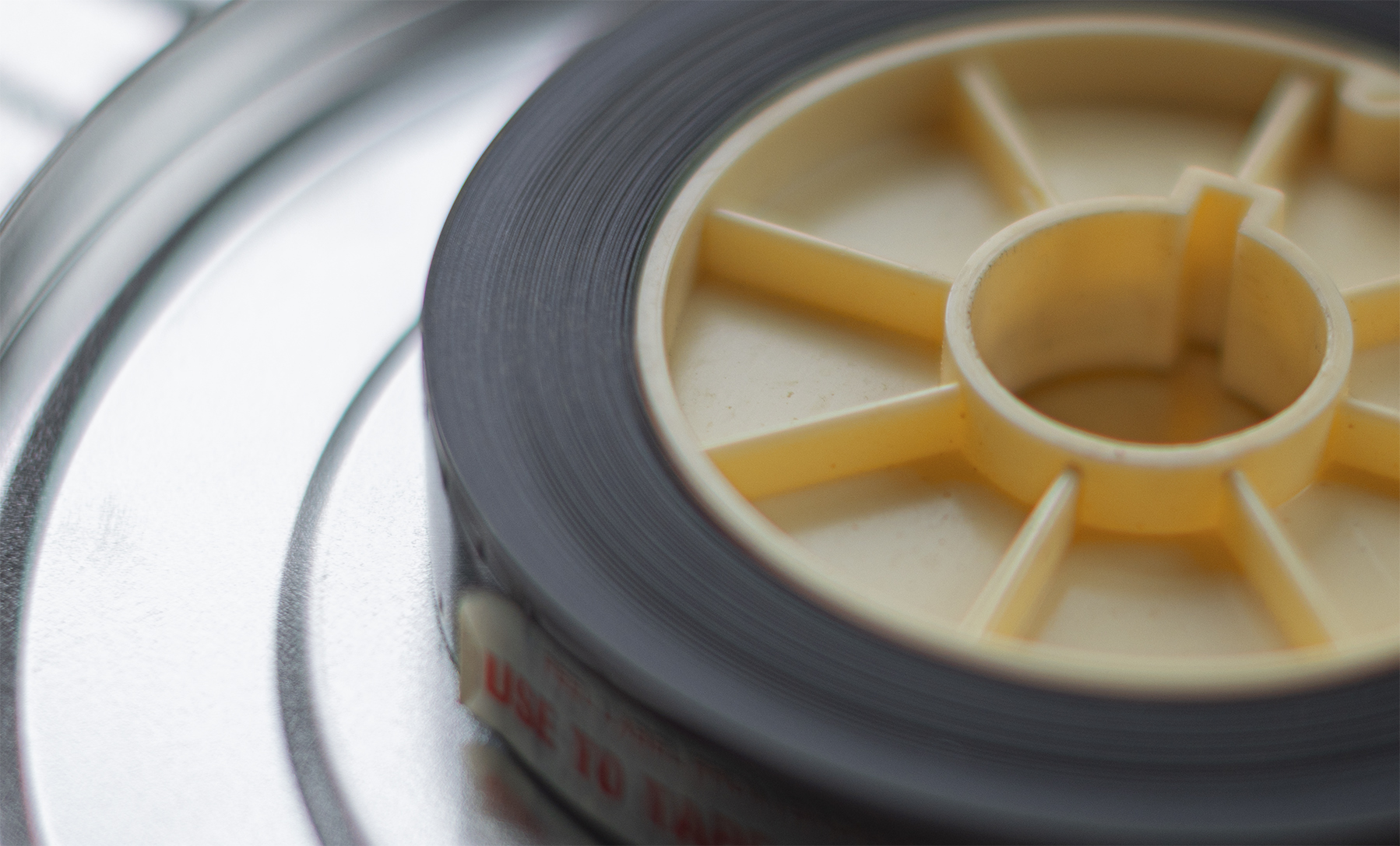
Last year, I pulled out a long untouched roll of 16mm film and walked it up the street to get it digitized at a local photo studio. The contents had laid hidden and pristine inside a metal canister, for more than 30 years. I felt ready to see it again.
I made the film in college, a requirement of my degree in art and film from Hampshire College. It told a story I’ve never shared publicly, not even with my family, save for the fifty or so accumulated people who sat in a screening room at Hampshire College and watched it with me and my graduation committee. It was a huge moment for me, easily mistaken for the culmination of all my hard work. It was intense, but it wasn’t that.
My Hampshire education was beautifully complex. I spent the majority of my time at Hampshire studying art, music, motion and composition, three of which made it into the film. (There is no music, though strangely, I could always hear what it would have been.)
At the local studio, I was told the film would take a week or so to return. Instead, months passed. The owner told me at different times he “didn’t have the time to get to it”, “it will be done tomorrow”, that “a bulb had blown” and he “couldn’t find a replacement”, it’d “be a while”, and that he “didn’t really transfer 16mm anymore”. “Sorry, do you want to just come get it?”
When I arrived to pick up the film reel, the owner told me he hadn’t actually touched it. The comment gave me pause. I opened the canister and found what had laid pristine for 30 years had been put back jammed onto the spool mangled. Someone had the time for that, at least.
The owner feigned shock. He told me he was appalled, and blamed it all on “the girl.” I will never be able to prove this “girl” didn’t exist, but he’ll never be able to show me that she did. Then the owner then told me he knew a guy in Rhode Island. I could send the film to him for recovery. I stood there staring at the warped and twisted celluloid without responding. The print was irreplaceable. After a long and awkward moment he added that, if I wanted, he could take it down for me next week. I pushed the film towards him. I assumed I would never see it again. I was free.
I didn’t need my secrets back. I knew them well enough. I was ready to be at peace and I uncharacteristically decided that, if I was meant to see it again, I would. (I’m not an “everything-happens-for-a-reason”-guy.) I didn’t feel lighter, but I felt a sense of closure. The thing was done. I let it go.
Or so I thought.
Four or five weeks later I got a call. The film was back. It had been digitized. It could be picked up anytime. This, I did not expect. I headed to the studio and the owner handed me back my original print, and a small thumb drive on which he claimed the movie was saved.
I originally planned to sit down and watch it carefully with someone with me because, while I knew what it revealed, I didn’t remember what little landmines my younger self might have left behind. Also, the content makes me sad. But I didn’t wait. I put it in my laptop in the parking lot, telling myself I’d just check to see if the film had actually been transferred. I didn’t really believe it was done, but it was.
The transfer was beautiful – in its way. The colors were as strong as when Margie Waller, my Amherst College committee member, first commented on them. The pristine film had been scratched and broken, giving the movie the sound of a warm crackling fire with an occasional pop. My film had been aged for me — a patina worthy of its years.
Despite my plan to wait, 15 minutes later, I had watched it from beginning to end. What I found astonished me. I had remembered the first line, “I moved none of these objects,” but the rest of my words were only in hazy thoughts and outlines. I’d forgotten that I addressed “you” throughout the film and then I didn’t know who “you” was. were. is? …until the twist ending.
I’d forgotten the film had a twist ending. It’s unusual for a documentary. When it screened at Hampshire, right before my graduation, the response was intense. Jerome Liebling, one of Hampshire’s more famous and revered professors, grumbled that he had not been included on my committee. Abraham Ravett, my committee chair, let me know his complaint was a big deal and stood a little closer. A few friends came and hugged me, either because they didn’t realize what the film contained, or because they did. In the week or two that followed, people who hadn’t seen it asked if I would do another showing. I didn’t. I didn’t watch it again until the parking lot.
The movie was sad and awful and strangely beautiful and ugly. The context of the years only made the heartache of it more intense. The film’s monotonous too. It is one long monologue and the sound of the projector over a relentless rhythm of footage I won’t describe here. It was a deeply personal college film but it was also something I didn’t realize: It was a gift. It made me feel lighter. Cleansed. It took from me a burden and carried it through the years for me. I’m deeply grateful to my younger self, and to my dying school.
This work only exists because of Hampshire and I’m heartbroken that Hampshire is going away. I can’t tell you how much I had to learn to make that little film. What other place would have allowed me to explore so widely and deeply in such a vast array of subjects that I could slide from animation to documentary and one day go back again? It was far from a perfect place and my complaints about it often outweighed my affection — but I always had a feeling for what it could be. Hampshire, for me, was always about promise.
Hampshire failed me too. Years later, when I returned to animation, and I met with producers and writers and animators at DreamWorks and Sony and Weta, Hampshire didn’t adequately prepare me for the practical business of film. I was flying blind. I don’t believe anyone at Hampshire had the skillset to council me on what to say when a producer sees you as a story artist and wants to fly you out. (Hint: Don’t say, “I was thinking animator.”) But Hampshire taught me to keep going, think on my feet and keep trying. I’m still doing that now — something I’ll reveal here, soon, I hope.
Maybe that’s why I keep trying to solve Hampshire’s problems — like a little subroutine running in the background all day long. With fascism and its compulsive desire for ignorance raging, how can a place so deeply opposed to ignorance and inequality survive in such a fragile state? There is already a deep tax on progressive thought baked into these past two years, as our institutions and safeguards fall and those few good people with means rush to save what they can at their own expense.
Of one thing, I am certain: If Hampshire’s passionate, interconnected, deep and broad model of learning can be preserved, we are going to need it for the aftermath of the coming years. Even if we need to put it in a box, or metal canister, and hold it quietly for a while, it will be a gift every one of us will be glad for in those later days. Except for my beloved and gutted NASA, America doesn’t tend to think long term or far ahead, but we can. I don’t want to turn around one day and look for Hampshire and find nothing there.